

Local SEO for contractors is the process of making your business highly visible in local search results when a potential customer in your service area is looking for what you do. Think about it: when a homeowner has a leaky pipe, they’re not flipping through the phone book. They’re grabbing their phone and searching “plumber near me.” The implication is clear: if you’re not visible in those moments, you’re invisible to the modern customer.
Being at the top of those results is the difference between getting that emergency call and your competitor getting the job.
Why Local SEO Is Your Most Powerful Tool
Word-of-mouth is great, but its main drawback is that you can’t control when it happens. Local SEO puts you in the driver’s seat. It’s the engine that gets your business in front of high-intent customers at the exact moment they need you most, giving you a predictable, sustainable pipeline of leads.
Relying on old-school methods like flyers is like having a single fishing line in the ocean while your competitors are using a giant net. Mastering your digital presence is how you create a predictable, sustainable pipeline of people who are ready to hire you right now.
From Search To Service Call
The path from a Google search to a booked job is incredibly short. That “roof repair near me” search kicks off a powerful and immediate chain reaction.
The numbers don’t lie. A staggering 76% of people who search for something “near me” on their phone visit a related business within 24 hours. Even better, 28% of those local searches lead to a purchase. The takeaway here is that local SEO isn’t just about getting seen—it’s a direct line to paying customers.
Your Google Business Profile is often the first thing they see, acting as your digital storefront.
This profile gives them the critical info they need—your services, reviews, and phone number—to make a quick decision and call you first.
The Benefits For Your Contracting Business
Investing in a solid local SEO strategy isn’t just about getting more website traffic; it’s about getting the right traffic and seeing a real impact on your bottom line.
Here are the practical benefits you stand to gain:
- Higher Quality Leads: You’re connecting with homeowners who have an urgent problem and are actively looking for a solution in your service area. These aren’t tire-kickers; these are customers with high commercial intent.
- Increased Trust and Credibility: Showing up at the top of Google, backed by positive reviews, instantly builds authority. It tells customers you’re a reputable choice before they even visit your website.
- A Real Competitive Advantage: Many contractors are still behind the curve online. A strong local SEO game plan lets you capture the jobs they’re missing out on, effectively leapfrogging less tech-savvy competitors.
- Better ROI Than Traditional Ads: Unlike paid ads that vanish the second you stop paying, the work you put into local SEO builds long-term digital assets. Your optimized Google profile and service pages will keep generating leads for years, creating a compounding return on your initial investment.
Local SEO vs Traditional Advertising for Contractors
It can be tempting to stick with what’s familiar, like running an ad in a local paper or printing door hangers. But when you compare the effectiveness and return on investment, local SEO is in a league of its own. Here’s a key comparison to illustrate the difference.
Here’s a straightforward look at how they stack up:
| Attribute | Local SEO | Traditional Advertising |
|---|---|---|
| Audience Targeting | Hyper-targeted. Reaches customers actively searching for your services right now. | Broad and untargeted. Hits everyone, whether they need your service or not. |
| Lead Intent | High-intent. Customers have an immediate need and are ready to hire. | Low-intent. Passive audience; you’re hoping to catch someone’s eye by chance. |
| Cost | Ongoing investment. Builds a long-term asset that keeps working for you. | Recurring expense. The ads stop the moment you stop paying. |
| Measurability | Highly trackable. You can see exactly how many calls, clicks, and leads you get. | Difficult to track. Hard to know how many people saw your flyer and called. |
| Lifespan | Long-term. Your rankings and online reputation grow in value over time. | Short-term. A flyer is seen once and then thrown away. |
The implication is clear: while traditional methods might bring in a job here and there, a well-executed local SEO strategy builds a powerful, lead-generating machine that consistently brings in high-quality customers for the long haul.
Turn Your Google Business Profile into a Lead Magnet
Forget your website for a second. For most contractors, your Google Business Profile (GBP) is the most powerful weapon in your local marketing arsenal. Think of it as your digital storefront. It’s the modern-day yard sign, but instead of reaching one street, it puts your business in front of thousands of local homeowners actively looking for your services.
When someone in your town searches “kitchen remodeler near me,” their first impression of your business will likely be your GBP. It’s where they see your work, read reviews, and find your phone number. Getting this right isn’t just a good idea; it’s non-negotiable if you want to win in your local market.
A neglected profile is like a boarded-up shop—it tells potential clients you’re not open for business and sends them straight to the competition.
Nail the Foundational Details
Before you get fancy, you have to get the basics perfect. Any slip-up here sends mixed signals to Google and can tank your local rankings. Google runs on trust, and a consistent digital footprint is a massive trust signal.
- Business Name: Use your exact, legally registered business name. It’s tempting to stuff keywords in there like “Austin’s Best Roofer,” but this violates Google’s guidelines and is a fast track to getting your profile suspended.
- Address and Service Areas: If you have an office that customers can visit, list the address. But for most contractors who work out of a home office, you’ll operate as a service-area business. This means you hide your physical address and instead define the specific cities, counties, or zip codes you cover.
- Phone Number: This is crucial. Use one consistent, local phone number across your GBP, your website, and every other online directory. Mismatched numbers are a red flag for Google and a point of confusion for customers.
Key Takeaway: Consistency across your Name, Address, and Phone number (NAP) is the bedrock of local SEO. Every single mention of your business online should match perfectly. This builds the authority and trust that search engines need to see.
Choose Your Categories Wisely
Your business categories tell Google exactly what you do. This directly impacts which searches you show up for, making it one of the most critical parts of your profile.
Your primary category needs to be the most accurate and specific description of your main service.
Practical Example: If you’re a roofer, your primary category should be ‘Roofing Contractor,’ not the broader ‘General Contractor.’ This simple choice is the difference between ranking for a high-intent search like “roof repair near me” and getting lost in the noise.
After you’ve locked in your primary category, add secondary ones to cover everything else you do.
- Primary Category: Roofing Contractor
- Secondary Categories: Siding Contractor, Gutter Cleaning Service, Window Installation Service
This strategy tells Google the full scope of your expertise, helping you appear for a wider range of relevant searches without weakening the focus on your core specialty.
Bring Your Business to Life with Rich Content
A bare-bones profile is a missed opportunity. To turn your GBP into a machine that actually generates leads, you need to use every feature Google gives you to showcase your work and build credibility.
Write a Keyword-Rich Business Description
This is your chance to sell your business and strategically include your most important local keywords. Don’t just list your services. Tell a story about what makes you the best choice in your area. Weave in natural-sounding phrases like “licensed home remodeler in [City],” “family-owned construction company serving [County],” and “[Your City]’s trusted deck builder.”
Upload High-Quality, Geotagged Photos
Photos are undeniable proof of your craftsmanship. People want to see your work before they even think about calling you. You should be constantly uploading a stream of new images showing:
- Finished Projects: The before-and-afters are pure gold.
- Your Team on the Job: This adds a human touch and builds instant trust.
- Your Branded Vehicles and Equipment: It reinforces your professionalism.
Actionable Insight: Before you upload your photos, geotag them with the GPS coordinates of the job site. This gives Google hard data proving that you’re actively working in the service areas you claim.
Leverage Google Posts and the Q&A Feature
Think of Google Posts as free mini-ads that appear right on your profile. Use them weekly to show off a recently completed project, highlight a special offer, or talk about a specific service. An active profile signals relevance to Google.
Don’t wait for customers to ask questions in the Q&A section—do it yourself. Preemptively ask and answer the questions you get all the time. Answering things like “Are you licensed and insured?” or “What’s your warranty on a new roof?” right on your profile builds immediate trust and filters out unqualified leads. You control the narrative and give prospects the info they need without them even having to ask.
Optimizing Your Website for Local Searches
Optimizing your Google Business Profile is a huge first step. But it’s just that—the first step. Your website is your home base, the digital showroom where you prove you’re the right contractor for the job. To turn it from a simple online brochure into a lead-generating machine, you have to speak your customers’ language.
That means digging into the exact phrases homeowners are plugging into Google when they have a problem. This is what separates a website that just sits there from one that actively pulls in new projects.
Finding Keywords That Actually Bring in Business
Forget generic terms like “construction.” Your potential clients have a specific problem, and they’re searching for a specific solution. The real magic in local SEO for contractors is targeting keywords that scream “I need to hire someone now.”
Put yourself in the homeowner’s shoes. What would you type?
- “kitchen remodeling in Austin”
- “licensed electrician Dallas TX”
- “emergency roof repair near me”
- “cost to build a deck in Houston”
These aren’t just searches; they’re cries for help. When you build your site around these types of phrases, you attract qualified leads who are way further down the road to making a hiring decision.
Practical Example: Ranking for “remodeling contractor” sounds impressive, but it’s far more profitable to be #1 for “bathroom remodel in the Heights neighborhood.” Why? Because the person searching for that is your perfect customer with a specific need, not just a window shopper.
To get you started, here are some simple formulas for finding high-intent keywords that capture leads at different stages of their journey.
High-Intent Keyword Formulas for Contractors
| Searcher Intent | Keyword Formula | Example |
|---|---|---|
| Problem Aware | [Problem] + [Location] | “leaky roof repair Houston” |
| Solution Aware | [Service] + [Location] | “roof replacement Dallas” |
| Cost Conscious | [Service] + “cost” + [Location] | “cost to replace roof in Austin” |
| Ready to Hire | “best” + [Service] + [Location] | “best roofing company in San Antonio” |
| Urgent Need | “emergency” + [Service] + “near me” | “emergency plumber near me” |
This framework helps you think beyond just your core service and tap into what your potential customers are actually thinking and typing into search engines.
Build Your Digital Territory With Hyper-Local Service Pages
Here’s one of the most powerful plays in the local SEO book: create dedicated pages on your website for each service you offer in each specific location you serve. Don’t just throw “Austin” on your homepage and call it a day. Get granular. Build out a page for “Home Remodeling in Round Rock” and another one for “Deck Installation in Lakeway.”
These hyper-local pages are gold for both customers and Google. On each one, you can:
- Feature photos from projects you’ve actually done in that town.
- Casually mention local landmarks or street names to show you know the area.
- Post testimonials from happy clients who live right there.
This strategy screams to Google that you’re a legitimate local authority. It dramatically boosts your chances of showing up in the map pack and the top organic results for searches in those specific towns. For a more detailed breakdown, our business SEO cheat sheet gives you a solid framework for setting these pages up.
Nail Your On-Page SEO Elements
Once you’ve got your keywords and your page structure mapped out, it’s time to put them into action. On-page SEO is all about making small, crucial tweaks to your site’s content and code. It’s how you signal to search engines exactly what each page is about.
Contractors everywhere know that leads are the lifeblood of their business, and local SEO is an absolute workhorse. A staggering 75% of local businesses say it generates more leads than any other marketing tactic they use. For a contractor, the Google Map Pack is prime real estate, and having the right keywords on your website is a massive factor in claiming your spot.
Let’s look at a real-world before-and-after of optimizing a title tag and meta description for a roofer in Dallas.
Before Optimization:
- Title Tag: Our Services | Dallas Roofing Co.
- Meta Description: We offer a wide range of roofing services. Contact us today to learn more about how we can help with your next project.
After Optimization:
- Title Tag: Expert Roof Repair & Replacement in Dallas, TX | Dallas Roofing Co.
- Meta Description: Need licensed roof repair in Dallas? We specialize in leak repair, storm damage, and full roof replacements. Get your free, no-obligation quote today!
See the difference? The “after” version is worlds better. It packs in the service, the location, and a clear call to action. It directly mirrors what a potential customer is searching for and gives them a compelling reason to click on your site instead of the competitor’s. Applying this simple process across your main service and location pages will turn your website into a top performer.
Building a Reputation with Reviews and Citations
Your craftsmanship might be the best in town, but online, your reputation is built on trust. And the two biggest trust signals are customer reviews and business citations.
Think of these as the digital version of a neighbor leaning over the fence to give a referral. A potential client who’s never met you needs proof that you’re the real deal. So does Google.
For contractors, reviews aren’t just a nice-to-have; they’re a core part of winning new business. In 2025, an overwhelming 75% of consumers ‘always’ or ‘regularly’ read online reviews when looking for local businesses, trusting them as much as a personal recommendation. And where are they looking? Google, Maps, Yelp, and Facebook are the heavy hitters. You can dig into more of these fascinating local search statistics from Backlinko.

Cultivating a Stream of Positive Reviews
A steady flow of five-star reviews doesn’t just happen. It comes from a simple, repeatable process you bake right into your workflow.
The trick is to ask when the client’s satisfaction is at its peak—right after you’ve finished the job and they’re admiring your work. Don’t just hope they’ll remember to leave a review. Ask them directly.
Actionable Insight: A quick text or email works wonders: “Hi [Client Name], we loved working on your [project type]. If you have a moment, would you mind sharing your experience on Google? It helps our small business a lot. Here’s a direct link: [Your Google Review Link].”
Responding to every single review is just as crucial. It shows you’re paying attention and you value what your customers have to say.
- For Positive Reviews: Get specific. A generic “Thanks” is fine, but “Thank you, [Client Name]! We’re so glad you love the new deck. It was a pleasure working with your family in [City]” shows you remember the job and the person.
- For Negative Reviews: Always respond quickly and professionally. Acknowledge their frustration, offer to take the conversation offline to fix it, and never, ever get into a public argument. Your calm, helpful response isn’t just for them—it’s for every future customer reading it.
Why Citations Are Your Digital Footprint
Beyond reviews, local citations are simply mentions of your business’s core info—Name, Address, and Phone number (NAP)—across the web. Think of each one as a tiny vote of confidence confirming your business is legitimate and located where you say it is.
Google’s algorithm gobbles up these mentions to verify that you’re a real, active contractor in the service area you claim.
The absolute golden rule here is consistency. Every single listing, from your Google Business Profile to a tiny industry directory, must have the exact same NAP. A small difference, like using “St.” on one site and “Street” on another, creates confusion for search engines and can ding your local rankings.
Crucial Insight: An inconsistent NAP is one of the biggest red flags for Google. It erodes trust and signals to the algorithm that it can’t be sure about your business details, which is a direct path to lower rankings in the local pack.
Finding the Right Directories for Contractors
Not all directories are created equal. Sure, sites like Yelp and the Better Business Bureau are important, but for contractors, the industry-specific sites are where the real magic happens. These are the platforms where your ideal customers are actively looking for your services.
You’ll want to focus your efforts on getting listed on high-authority sites that are directly relevant to the home services industry.
Top Citation Sources for Contractors
| Directory Type | Platform Examples | Benefit for Contractors |
|---|---|---|
| General Directories | Yelp, Yellow Pages, Nextdoor | Broad visibility and trust signals recognized by all search engines. |
| Home Service Platforms | Angi, Houzz, Thumback | Reaches high-intent homeowners actively looking for contractors. |
| Local & Community | Chamber of Commerce, Local business associations | Cements your status as a legitimate, engaged local business. |
| Review-Focused Sites | Birdeye, Trustpilot, GuildQuality | Provides third-party validation and social proof of your quality. |
Think of it this way: a powerful portfolio of reviews and consistent citations is a classic one-two punch. The reviews build trust with potential customers, and the citations build authority with search engines. Together, they create the reputational bedrock you need to stand out and win more jobs.
Winning with Local Links and Technical SEO
Alright, once you’ve dialed in your website content and online reputation, it’s time to get into the stuff that really separates the top-ranked contractors from everyone else. This is where the magic happens: local link-building and technical SEO.
Think of these as the high-performance upgrades for your business. They take a solid online presence and turn it into an unstoppable lead-generating engine. Links from other respected local sites are like powerful “votes of confidence” in Google’s eyes, and a technically clean website ensures that both search engines and your future customers have a flawless experience.
Earning Local Links That Actually Matter
Forget about spamming your website address all over the internet. For a contractor, effective link-building is about weaving your business into the fabric of your local community—both online and off.
The goal is simple: get other trusted local businesses, organizations, and news outlets to point back to your site. This sends a massive signal to Google that you’re a legitimate, respected player in your service area. This doesn’t have to be complicated.
Here are a few practical examples for earning local links that move the needle:
- Sponsor a Community Event: That local little league team, the charity 5K, or the town’s summer festival? They almost always have a sponsors page with a link back to your website. It’s a fantastic, highly relevant local signal and great PR.
- Partner with Other Local Pros: You already work with real estate agents, interior designers, mortgage brokers, and plumbers. Create a “trusted partners” page on your site and feature them. Then, ask them to do the same for you. It’s a win-win that builds valuable referral networks.
- Join the Chamber of Commerce: This is often the easiest and most authoritative first link you can get. Most local Chambers have an online directory that includes a link to member websites. It’s a no-brainer.
These aren’t just empty SEO tasks; they build real-world goodwill that reinforces your reputation as a trusted local contractor.
Making Technical SEO Simple for Your Website
“Technical SEO” sounds intimidating, I know. But for most contractors, it really just boils down to two things: making sure Google can clearly understand what your business does, and making sure your site is fast and dead simple to use on a phone.
Helping Google Understand Your Business with Schema Markup
Schema markup is basically a secret language for search engines. It’s a small bit of code you add to your website that acts like a digital name tag for Google. It explicitly tells search engines all the important details—your services, service area, hours, and phone number—in a format they can perfectly understand.
Key Takeaway: Implementing
LocalBusinessschema is huge. It helps Google confidently show your information in the map pack and can unlock “rich snippets”—things like your star rating or business hours appearing right in the search results. This makes your listing way more compelling.
Why a Mobile-Friendly Website is Non-Negotiable
More than 60% of searches now happen on a phone. For contractors, that number is probably even higher. Think about it: a homeowner is standing in the kitchen they hate, and they pull out their phone to search for a remodeler.
If they land on your site and have to pinch and zoom just to read your services, they’re gone. Instantly.
A fast, mobile-friendly site isn’t just a “nice-to-have” anymore; it’s a critical part of your sales funnel. Your website has to load quickly and guide visitors effortlessly to your contact form or phone number. If you’re looking for pointers on this, our guide has some excellent website design tips for small business that can make a massive difference.
Getting these foundational technical pieces right ensures that all the traffic you work so hard to earn actually turns into paying jobs.
How to Measure Your SEO Success
All the time you’ve poured into your Google Business Profile, service pages, and link-building doesn’t mean much if you can’t see what’s actually working. Measuring local SEO isn’t about chasing vanity metrics like “website visitors.” It’s about tracking the specific actions that directly lead to more jobs and a healthier bottom line.
You have to cut through the noise and focus on the key performance indicators (KPIs) that really matter for a contractor. This means getting beyond generic data and zeroing in on the numbers that show real, tangible customer interest.
Key Performance Indicators That Matter
For a contracting business, good SEO means the phone rings and quote forms get filled out. Simple as that. Forget the complicated dashboards for a minute and concentrate on what actually fills your project pipeline.
Your main focus should be on tracking these core metrics:
- Google Business Profile Actions: How many people clicked to call you right from your GBP listing? How many requested driving directions? These aren’t just clicks; they’re high-intent leads from people ready to hire.
- Website Form Submissions: Every single time someone fills out your “Request a Quote” or “Contact Us” form, that’s a direct result of your SEO efforts paying off.
- Tracked Phone Calls: Using call tracking numbers on your website is a game-changer. It tells you exactly how many inbound calls came directly from your online marketing, not a yard sign or a referral.
- Keyword Rankings in Your Service Area: Are you showing up when people search for “bathroom remodel [Your City]” or “roofer near me”? Watching your rankings climb for these money-making terms proves your visibility is growing where it counts.
To keep a close eye on these KPIs, a couple of tools are non-negotiable—and thankfully, the most powerful ones are free. Google Search Console shows you exactly which keywords are bringing people to your site. Google Analytics then tells you what those people do once they arrive.
Together, they paint a clear picture of what’s working and what isn’t, letting you make smart decisions instead of just guessing. If you want to explore more options, our guide on the best marketing tools for small business can help you build out your toolkit.
Your Month-By-Month SEO Action Plan
Seeing a real return from local SEO doesn’t happen overnight. It requires a steady, phased approach where each step builds on the last.
This timeline gives you a visual roadmap, starting with the absolute foundation—your Google Business Profile—before moving into on-page website optimizations and finally building local authority through links.
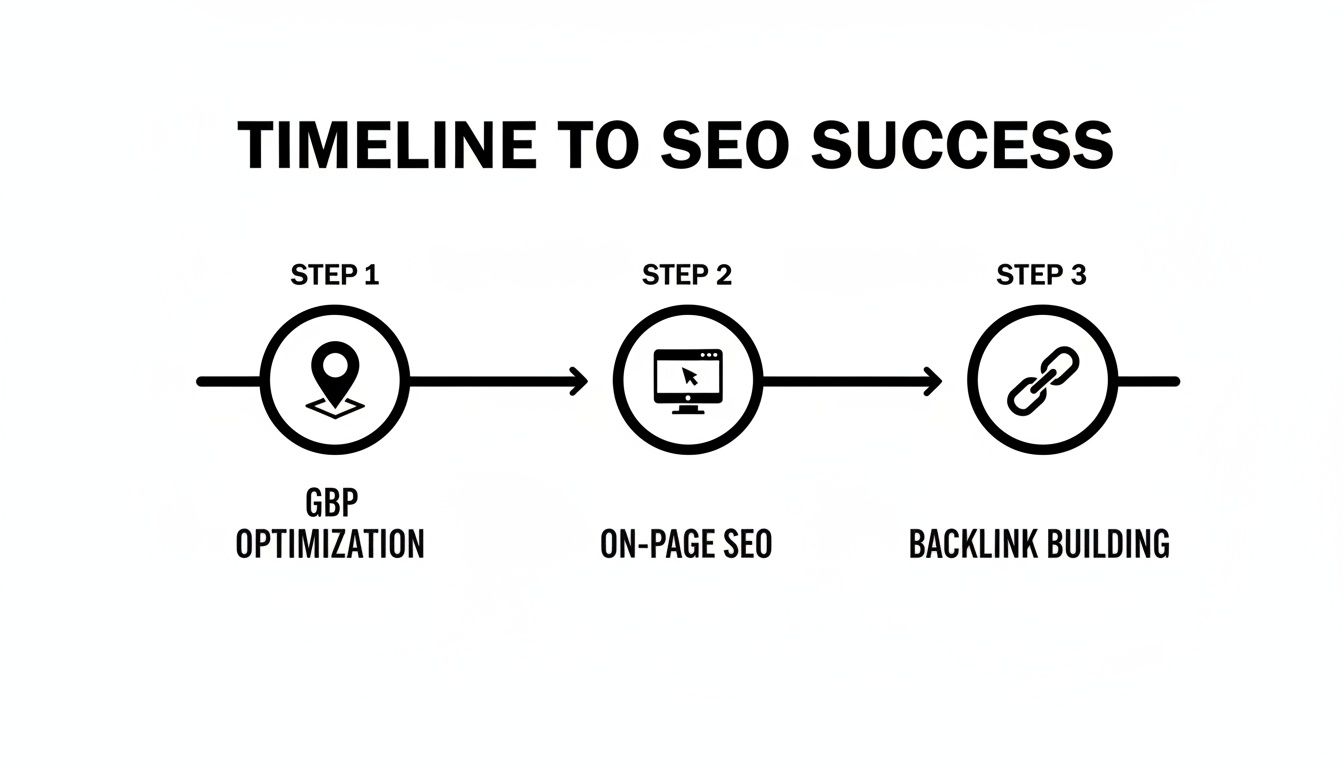
Remember, local SEO is a marathon, not a sprint. Real, lasting success comes from layering these critical pieces over time to build a rock-solid presence in your community.
Got Questions About Local SEO? I’ve Got Answers.
When I talk to contractors about local SEO, the same handful of questions pop up every single time. Let’s clear the air on a few of the big ones so you can focus your energy on what actually moves the needle.
One of the first things everyone wants to know is, “How long will this take?” It’s a fair question. While you can see some quick wins—a fully decked-out Google Business Profile can sometimes bring in calls within a few weeks—real, sustainable local SEO is a long game. Think of it like building your reputation in a new town; it doesn’t happen overnight.
You should plan on seeing serious momentum and a steady stream of leads rolling in within about 3 to 6 months. That’s the typical timeframe for your authority to build and your rankings to solidify.
Do I Really Need a Physical Office to Show Up on the Map?
This is a huge point of confusion for roofers, plumbers, electricians—pretty much any contractor who works at the customer’s location. The answer is a hard no.
You absolutely do not need a physical, public-facing office to rank in local search. Google built its system specifically for service-area businesses like yours. Instead of listing a storefront you don’t have, you simply tell Google the cities, counties, or zip codes you serve. That’s your territory.
From there, you prove you actually work in those areas with other, more powerful signals:
- Geotagged photos from your job sites.
- Customer reviews that name-drop the specific towns you worked in.
- Dedicated service pages on your website for each key location (e.g., “Roofing in Springfield”).
This is how you dominate your service area without ever paying rent on an office nobody would visit anyway.
If you only have the time or budget to do one thing for your local marketing, make it this: Completely fill out your Google Business Profile. It is, without a doubt, the 80/20 of local SEO for contractors. Fill out every single section—services, photos, a good keyword-rich description, Q&A, and accurate hours. This is your digital storefront, and it’s the fastest way to boost your visibility.
Ready to turn your website into your best lead generator? Small Business Website Design builds clean, mobile-friendly sites with SEO baked in, so you can stop worrying about marketing and start booking more jobs. Learn how we help contractors grow online.