
Choosing the best ecommerce platform for your small business comes down to one thing: finding the perfect match for your budget, technical comfort level, and vision for growth. There’s no single “best” answer for everyone. The key difference lies in the trade-off between convenience and control. For most entrepreneurs who just want a powerful, all-in-one solution to get running fast, Shopify is an incredible starting point. But if you’re already familiar with WordPress and want total creative control, WooCommerce offers customization that’s hard to beat.
How To Choose Your Small Business Ecommerce Platform

Picking your ecommerce platform is one of the most critical decisions you’ll make. This isn’t just about choosing a tool; it’s about building the entire foundation of your online store. The platform you select has long-term implications, shaping everything from daily inventory management to your site’s ability to handle a massive traffic spike during a Black Friday sale.
Get it right, and your platform becomes a silent partner, empowering growth with tangible benefits like streamlined operations and higher conversion rates. Get it wrong, and you’ll constantly hit frustrating roadblocks, leading to lost sales and wasted time.
The goal isn’t to find the one platform that rules them all, but to find the right fit for your specific business. A practical example: a local boutique owner taking her shop online has wildly different needs than a creator selling digital products. The boutique owner benefits from a simple, beautiful storefront with integrated point-of-sale, while the creator needs sophisticated tools for managing digital downloads and recurring payments.
To provide actionable insights, I’ve put together a quick guide matching the top platforms with the types of businesses they serve best. Think of this as your starting point before we dive into deeper comparisons.
At-a-Glance Guide To Top Ecommerce Platforms
This table offers a key comparison of the top contenders, helping you quickly identify which platform aligns with your business model and technical skills.
| Platform | Best For | Pricing Model | Technical Skill Required | Key Benefit |
|---|---|---|---|---|
| Shopify | Beginners and businesses focused on rapid, all-in-one setup. | Monthly Subscription | Low | Speed to market and ease of use. |
| WooCommerce | Businesses wanting full control and WordPress integration. | Open-Source (Requires Hosting) | Medium to High | Unmatched customization and ownership. |
| BigCommerce | Growing businesses with large product catalogs and no transaction fees. | Monthly Subscription | Low to Medium | Scalability without punishing fees. |
| Wix/Squarespace | Creatives, service providers, and content-focused businesses. | Monthly Subscription | Very Low | Superior design flexibility for visual brands. |
Ultimately, the choice boils down to a classic trade-off: convenience versus control. Hosted platforms like Shopify offer the benefit of handling all the technical heavy lifting—security, updates, hosting—so you can focus on selling. The implication is less flexibility. On the other hand, a self-hosted solution like WooCommerce provides the benefit of complete ownership and endless flexibility, but the implication is that you’re responsible for managing hosting, security, and maintenance.
A busy coffee roaster, for instance, would benefit from choosing Shopify to launch their online store in a weekend without worrying about server configurations. An entrepreneur with a clear design vision and some web development for small businesses know-how might pick WooCommerce to build a completely custom shop on a tighter budget.
Actionable Insight: Your platform choice is a long-term commitment. Think about where your business will be in three years. A platform that seems perfect today might become restrictive tomorrow if it can’t support your scaling ambitions. Choose for where you’re going, not just where you are.
Hosted vs Self-Hosted Platforms Explained
Before comparing specific platforms like Shopify or WooCommerce, you must understand the most fundamental difference: hosted vs. self-hosted. This choice dictates your flexibility, daily responsibilities, and long-term costs. It’s the ultimate trade-off between total convenience and absolute control.
Think of a hosted platform like leasing a fully-equipped, modern retail space in a high-end mall. The benefit is that management handles all the critical-but-boring stuff: security, building maintenance, and ensuring the lights stay on. You just move in and start selling.
A self-hosted platform, on the other hand, is like buying your own plot of land and building a custom store from the ground up. The architectural plans (the software) might be free, but the implication is you’re responsible for pouring the foundation (hosting), maintaining the structure, and installing your own security system.
What Does Ownership Really Mean?
With hosted platforms, often called Software-as-a-Service (SaaS), you’re paying a monthly fee for the benefit of using their powerful, purpose-built technology and support. You absolutely own your data—your customer lists, product info, and sales numbers are all yours. But you’re operating within their ecosystem. Platforms like Shopify or BigCommerce are the big players here.
You can’t just pack up your entire Shopify store and move it to a different server. You’re renting their top-tier infrastructure, not owning it.
Self-hosted platforms, like the incredibly popular WooCommerce, are usually open-source. This means the core software is free, and the key benefit is complete ownership of every single file. You can dig into the code, pick any hosting company you want, and build a truly one-of-a-kind shopping experience. That freedom, however, comes with the implication of hefty technical responsibility.
Key Difference: Hosted platforms sell you a service (convenience and support); self-hosted platforms give you a tool (freedom and control). The right choice boils down to whether you want to focus 100% on running your business or if you also want to be the one managing the technology that powers it.
The Hidden Responsibilities of Each Model
The real-world implications of this decision show up in your day-to-day operations. As a small business owner, you have to weigh not just the sticker price but the ongoing investment of your time and energy.
Hosted Platform Responsibilities (Lower Technical Burden):
- Your Job: Add products, design your store with their easy-to-use tools, and market your business. The key benefit is simplicity.
- Provider’s Job: They handle server uptime, security patches, PCI compliance for payments, and all the core software updates.
Self-Hosted Platform Responsibilities (Higher Technical Burden):
- Your Job: Pretty much everything. The implication is you need to research and pay for web hosting, install the ecommerce software, manage security plugins, perform regular backups and updates, and troubleshoot any conflicts that pop up. If your site crashes at 3 AM on a Saturday, guess who’s fixing it? You are.
Let’s use a practical example: a critical security update. On Shopify, that update happens automatically behind the scenes. You probably won’t even know it happened. With WooCommerce, you’re responsible for backing up your site, running the update, and then checking to make sure it didn’t break any of your other plugins.
Choosing the best ecommerce platform for your small business starts with an honest assessment of how hands-on you’re willing—and able—to be with the tech side of things.
Comparing The Top Ecommerce Platforms For Small Business
Choosing the right ecommerce platform is a big deal. You’re not just picking software; you’re laying the foundation for your entire online business. The flashy ads don’t tell the whole story. Let’s cut through the noise with a key comparison of the day-to-day realities of running a store on the industry’s heavyweights: Shopify, WooCommerce, BigCommerce, and Wix.
Each platform represents a fundamentally different approach. The goal is to identify the one whose benefits best align with your budget, technical comfort, and business goals. Let’s break down the nuanced differences that actually matter.
Shopify: The All-in-One Powerhouse
Shopify has earned its reputation as the go-to for entrepreneurs who want to get selling, fast. Its core benefit is simplicity. It expertly handles all the technical headaches—hosting, security, payment processing—so you can pour all your energy into your products and customers.
Think of it as a turnkey solution. Everything you need is bundled into one monthly fee. This all-inclusive model is a dream for business owners who value speed and ease of use. A practical example: a jewelry maker can go from an idea to a beautiful, fully functional store in a single weekend without ever looking at a line of code.
But that convenience has an implication: you’re playing in Shopify’s sandbox. While its app store is massive, you’re ultimately operating within its ecosystem. The biggest catch is the fee structure. If you opt out of using their native Shopify Payments, you’ll be hit with extra transaction fees on every single sale, which can eat into your margins as you grow.
Key Differentiator: Shopify’s magic is its frictionless user experience. Its primary benefit is getting you from zero to selling as quickly as possible with an intuitive interface that even a complete beginner can master. There’s a reason it’s the market leader.
WooCommerce: The Path To Ultimate Control
WooCommerce is the polar opposite of Shopify. It’s a free, open-source plugin that transforms a WordPress website into a powerful ecommerce store. Its key benefit is handing you the keys to the kingdom, giving you unparalleled freedom and control over every pixel and function. If you can dream it, you can probably build it with WooCommerce.
The main benefit here is total ownership. You pick your own hosting, install any theme, and can dive into the code to create a bespoke shopping experience. This makes it perfect for businesses with specific needs or anyone wanting to tightly integrate their store with a content-heavy WordPress site. A food blogger, for example, could seamlessly add a shop to sell their cookbooks without managing two separate platforms.
Of course, with great power comes the implication of great responsibility. That “free” price tag is misleading. You’re on the hook for buying your own hosting, an SSL certificate, and often premium plugins for essential features. The real “total cost of ownership” for a serious WooCommerce store can easily match or even surpass Shopify’s monthly fees.
The market share numbers really tell the story of these two giants. Globally, Shopify leads with a 26.2% share, powering around 4.65 million sites. WooCommerce isn’t far behind, holding 20.1% of the market with over 3.5 million stores. This data shows just how dominant they are and how they appeal to different types of entrepreneurs. You can find more details on these market share trends to see their global impact.
BigCommerce: The Scalability Specialist
BigCommerce carves out its niche as the platform for serious sellers with big growth plans. It strikes a balance between the ease of a hosted platform like Shopify and a more robust, built-in feature set designed to handle huge product catalogs and high sales volume.
One of the most compelling benefits of BigCommerce is its fee structure. Unlike Shopify, it charges zero transaction fees on all of its plans, regardless of the payment gateway you use. The implication for a growing business is thousands of dollars in savings over time. For example, a small business selling auto parts with thousands of individual SKUs would find BigCommerce’s powerful product filtering and unlimited product variants essential from the start, without being penalized for success.
The platform is built for growth, with fantastic native features for multi-channel selling on marketplaces like Amazon and eBay. The key difference from Shopify is that more advanced functionality is included out of the box, whereas Shopify often relies on third-party apps. This means BigCommerce might have a slightly steeper learning curve, but it could save you a lot in monthly app subscriptions down the road.
Wix: The Creative-First Contender
Wix, known as the king of drag-and-drop website builders, has made serious moves into ecommerce. Its biggest benefit is its incredibly intuitive visual editor, which gives creative entrepreneurs unmatched design flexibility without needing technical skills.
For businesses where the visual brand is everything—think a photographer selling prints or a boutique with a small, curated collection—Wix is a fantastic choice. It gives you pixel-perfect control over your design that can be tough to achieve on other platforms without hiring a developer.
The implication is that its core ecommerce engine isn’t quite as muscular as dedicated platforms like Shopify or BigCommerce. It handles the basics beautifully, but businesses with complex inventory needs or plans for rapid scaling might bump up against its limitations. It’s easily the best ecommerce platform for small businesses that prioritize stunning visuals and have straightforward selling needs.
To make sense of all these details, it helps to see the features laid out side-by-side. This table offers a key comparison of the core capabilities of each platform, giving you a clearer picture of where each one shines.
Feature-by-Feature Platform Comparison
| Feature | Shopify | WooCommerce | BigCommerce | Wix Ecommerce |
|---|---|---|---|---|
| Ease of Use | Excellent (drag-and-drop) | Moderate (requires WordPress) | Very Good (structured editor) | Excellent (intuitive drag-and-drop) |
| Pricing Model | Monthly Subscription | Free Plugin (hosting/plugins extra) | Monthly Subscription | Monthly Subscription |
| Transaction Fees | 0% with Shopify Payments | 0% (gateway fees still apply) | 0% on all plans | 0% with Wix Payments |
| Customization | Good (themes & apps) | Excellent (total code access) | Very Good (themes & APIs) | Very Good (design flexibility) |
| Scalability | Excellent | Very Good (depends on hosting) | Excellent (built for growth) | Good (best for smaller catalogs) |
| SEO Features | Very Good | Excellent (with plugins like Yoast) | Excellent (powerful native SEO) | Good |
| App Marketplace | Massive (over 8,000 apps) | Huge (50,000+ WP plugins) | Good (growing selection) | Good (focused on design) |
| Best For | Beginners, dropshippers, brands wanting simplicity and speed. | Content-heavy sites, businesses wanting total control. | Fast-growing stores, sellers with large product catalogs. | Visually-driven brands, artists, boutiques with simple needs. |
Ultimately, the “best” platform is the one that removes friction and empowers you to grow. Shopify offers the benefit of speed, WooCommerce provides freedom, BigCommerce prepares you for scale, and Wix lets your brand’s visuals shine. Choosing the right one from the start will save you countless headaches down the road.
Which Platform Actually Fits Your Business? Real-World Scenarios
Alright, let’s move past the endless feature lists. The real decision-making starts when you apply these platforms to actual business situations. The best ecommerce platform isn’t the one with the most bells and whistles; it’s the one with the right tools for what you’re trying to build. This section provides practical examples and actionable insights to help you choose.
This simple flowchart nails the very first question you need to ask: are you prioritizing a quick, easy setup or do you need absolute technical control?
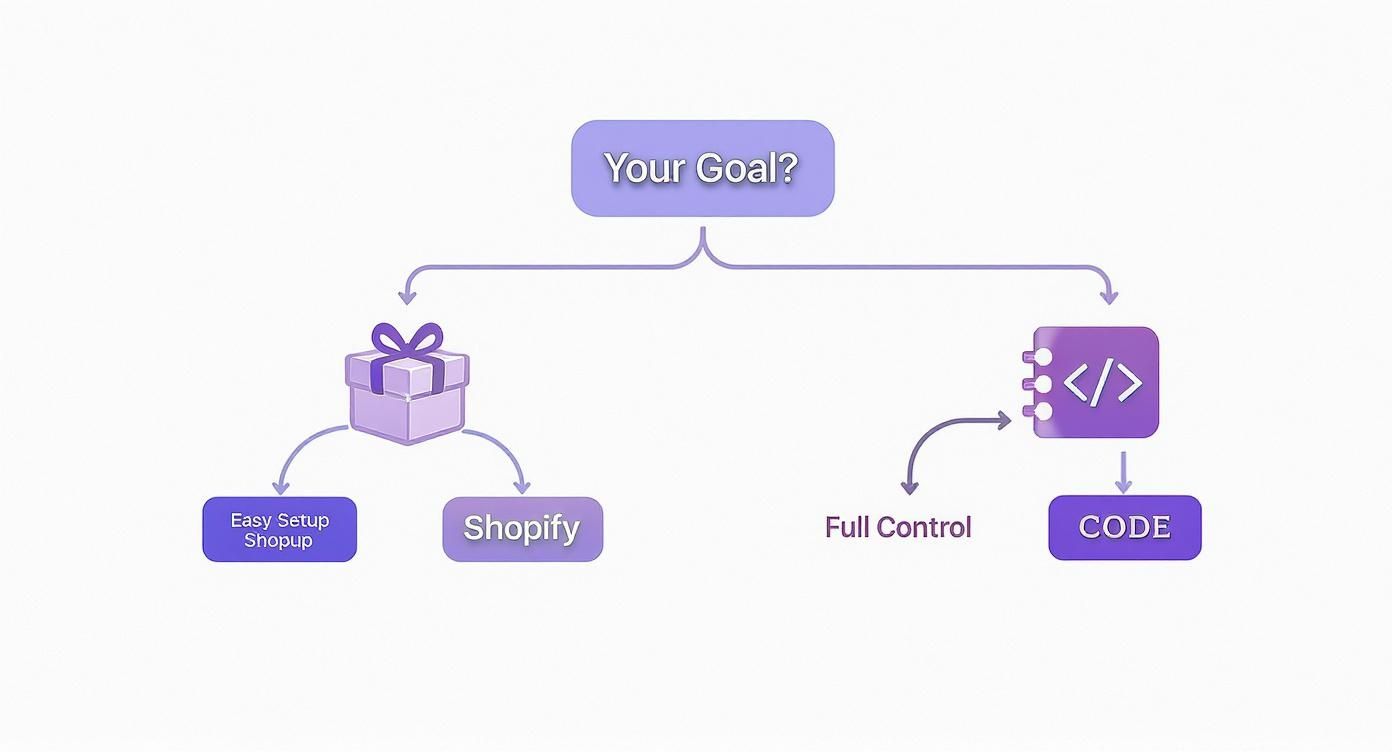
As you can see, the key difference boils down to a core dilemma. If you want a streamlined, powerful solution that’s ready to go, you’re probably heading toward Shopify. If deep customization from the ground up is your game, then WooCommerce is likely your answer.
Let’s dig into some common scenarios.
The Bootstrapped Startup on a Shoestring Budget
For a brand-new venture, every dollar counts. The main benefit you need is a professional store online fast without a huge upfront investment, and predictable monthly expenses to manage cash flow.
Recommended Platform: Shopify
I know, I know—WooCommerce is technically “free.” But the implication of that “free” tag is that the true cost of ownership can catch you by surprise. You have to account for hosting, security plugins, premium themes, and—most importantly—your own time spent on maintenance and troubleshooting.
Shopify’s Basic plan provides the benefit of one predictable monthly fee. It bundles in rock-solid hosting, an SSL certificate, and top-notch security, killing any surprise costs. The implication is a founder can focus 100% on products and marketing, not on learning to be a server administrator.
The Brand Primed for Rapid Scaling
This business has found its stride and is gearing up for major growth. We’re talking a huge product catalog, heavy traffic, and the need to sell everywhere—Amazon, Instagram, you name it. The biggest concern here is building on a foundation that won’t buckle under pressure or punish you with fees as sales take off.
Recommended Platform: BigCommerce
BigCommerce was practically built for this exact scenario. Its most compelling benefit is the 0% transaction fee on all its plans. As your sales volume explodes, this becomes a massive cost advantage.
It also comes packed with powerful multi-channel selling tools and handles large, complex product catalogs with unlimited variants right out of the box. The key difference is that on other platforms, getting that kind of functionality often means stacking up expensive third-party apps, increasing your monthly costs.
Actionable Insight: A platform’s fee structure is just as critical as its feature list. For a high-volume business, the benefit of saving 1-2% on every single transaction can free up thousands of dollars a month to pour back into marketing and inventory.
The Content-First Blogger or Creator
This entrepreneur already has an audience. Whether through a blog, a YouTube channel, or a massive social media following, they need to monetize that audience by selling merchandise, digital downloads, or courses. The number one priority is a seamless connection between their content and their store.
Recommended Platform: WooCommerce
This one’s a no-brainer. Since WooCommerce is a WordPress plugin, its benefit is an unmatched ability to merge content and commerce. You can run your blog and your store from a single dashboard, creating a perfectly cohesive brand experience.
This deep integration opens up all sorts of creative marketing opportunities, like embedding “buy now” buttons directly into your most popular articles. The market share data really tells this story. In the US, Shopify has a commanding 27% market share, showing it’s the go-to for straightforward commerce. But in a market like India, WooCommerce leads with a 44% share, highlighting its appeal where deep content integration and open-source control are valued more. You can see more on these global platform preferences.
The Local Brick-and-Mortar Moving Online
Think of a local boutique or a neighborhood cafe. They need to bring their physical shop into the digital world. Their main goals are simple: manage one unified inventory for both in-store and online sales, and offer local options like in-store pickup. The system must be dead simple for the whole team to use.
Recommended Platform: Shopify with Shopify POS
This is where Shopify’s tightly integrated ecosystem absolutely shines. The Shopify POS (Point of Sale) system provides the benefit of syncing your inventory, sales, and customer data between your physical and online stores in real time.
A practical example: when an item sells in the shop, the website inventory updates instantly. The implication is this prevents you from accidentally selling the same product twice. This unified system simplifies everything and makes it incredibly easy to offer modern retail experiences like “buy online, pick up in store.”
Critical Success Factors Beyond The Platform
Picking the right ecommerce platform is a huge step, but it’s just the foundation. Real, sustainable success comes from how well you connect that foundation to every other part of your operation. The implication of a poor choice here is a disjointed business that’s hard to scale.
Think of your platform as the central hub of your business. How it talks to your social media channels, inventory system, and payment processor will ultimately determine whether you can scale or get stuck managing disconnected systems.
Meeting Customers Where They Shop
Multi-channel selling used to be a nice-to-have benefit; now, it’s a necessity. Your platform needs to act as a command center, seamlessly pulling in orders and syncing inventory no matter where a sale happens.
Here’s a practical example of what that looks like:
- Social Commerce: A customer sees your product on TikTok Shop and buys it right there in the app. A good platform integration means that order instantly appears in your main dashboard, ready for fulfillment, without you lifting a finger.
- Marketplace Integration: You can tap into massive audiences by listing products on Amazon or Etsy. The right platform ensures that when an item sells on Amazon, the stock count on your own website updates automatically.
The benefit of this unified setup is that it keeps you from overselling products you don’t have. It turns your platform from a simple website into a true sales engine.
Your ecommerce platform should be the brain of your operation, coordinating sales, inventory, and customer data across every channel. The actionable insight here is to eliminate manual updates and spreadsheets to free up your time for growth.
The Non-Negotiable Mobile-First Experience
The shift to mobile shopping isn’t just a trend; it’s completely reshaped retail. The global eCommerce market is expected to hit $6.86 trillion in 2025, with a huge chunk—projected at $2.51 trillion—coming from mobile devices. The implication is simple: if your site isn’t built for mobile first, you are actively leaving money on the table.
A mobile-first design is non-negotiable today. Your site has to load fast, be dead simple to navigate, and make checking out on a tiny screen feel effortless. We’re talking big, tappable buttons and a payment process that doesn’t make people want to throw their phone. For more practical advice, check out our guide on essential website design tips for small business.
Logistics and Payments: The Final Hurdles
I can’t stress this enough: how you handle payments and shipping can make or break a sale. These are the final hurdles a customer has to clear, and your platform’s flexibility here is critical.
- Payment Gateways: The benefit of supporting digital wallets like Apple Pay and Google Pay is a dramatic reduction in cart abandonment. Offering these one-click options removes friction at the most critical point.
- Shipping and Fulfillment: Your platform must integrate directly with shipping carriers. Customers expect to see real-time rates, and you need to be able to print labels and manage tracking without jumping to another system.
Ultimately, choosing a platform is about building an interconnected system that supports a modern, flexible, and customer-first business.
Deciding Between a DIY Setup and Hiring an Agency
Once you’ve picked your ecommerce platform, you hit another major crossroad: Do you build the store yourself, or do you bring in a professional? The best choice comes down to a practical trade-off between your time, budget, and technical comfort.
The Do-It-Yourself (DIY) route offers the benefit of low upfront costs. If you’re starting fresh with a simple product catalog, the user-friendly builders on most platforms make the process totally manageable. This approach gives you complete hands-on control right from the start.
But the moment your project gets even a little complicated, the math changes. The implication of a DIY approach to a complex project is often costly mistakes and frustrating delays. Hiring an agency stops being a luxury and becomes a smart, strategic investment.
When to Bring in The Experts
There are a few clear triggers that tell you it’s time to pay for professional help. If your project has any of these moving parts, the long-term benefit of an agency will almost always outweigh the initial cost.
- Complex Data Migrations: Moving thousands of customer profiles, order histories, and product SKUs from an old system is a minefield. The implication of one wrong move could be losing priceless data.
- Custom API Integrations: Does your store need to talk to a specialized inventory system, a third-party logistics (3PL) partner, or a unique accounting platform? That requires expert-level API work.
- Advanced SEO and Performance: If you’re moving a website that already has solid search engine rankings, a clumsy migration can obliterate your traffic overnight. An agency will handle all the critical URL redirects and speed optimizations to protect—and even boost—your SEO.
- Unique Functionality Needs: Need a custom product builder or some other special feature that you can’t find in an off-the-shelf app? You’re going to need a developer.
Actionable Insight: An agency’s real value isn’t just building something that looks good. It’s in preventing the expensive process of fixing critical errors months down the road. A professionally managed launch gets you to market faster and protects your most valuable business assets.
At the end of the day, the best ecommerce platform is the one that’s set up correctly from day one. If you’re facing any of these complexities, it’s worth exploring professional small business website design services.
A Few Final Questions
Navigating the world of ecommerce brings up a lot of questions. I get these all the time from small business owners trying to make the right call. Here are some clear, straightforward answers to the most common ones.
Can I Switch Ecommerce Platforms Later On?
Yes, you can absolutely migrate your store later, but I’ll be honest—it’s a major undertaking. The implication is a complex and highly technical process that involves carefully moving all your critical data, like product info, customer lists, and order histories.
This is one of those jobs where you often need specialized apps or an agency to make sure nothing gets lost. You also have to protect your hard-earned SEO rankings with proper URL redirects. To avoid that disruption, it’s always better to choose the best ecommerce platform for your small business from the start—one that can grow with you.
Actionable Insight: While switching is possible, it’s a significant project. Try to pick a platform that fits your long-term vision to prevent a costly and time-consuming migration down the road.
Which Ecommerce Platform Is Best For SEO?
There really isn’t a single “best” platform for SEO. Your success has more to do with your strategy than the tool itself. The key difference lies in control vs. simplicity. WooCommerce, built on WordPress, provides the benefit of incredible control through powerful plugins like Yoast SEO.
On the other hand, Shopify offers the benefit of excellent, easy-to-use SEO features right out of the box, which is perfect for beginners. BigCommerce is also known for its strong built-in SEO tools. Ultimately, the quality of your content and your optimization efforts will make the biggest difference.
What Is A Realistic Budget For An Ecommerce Website?
Your budget can vary quite a bit depending on your choice. For a hosted platform like Shopify, you’re looking at monthly fees ($30-$300+), plus a one-time cost for a premium theme (around $200-$400) and essential apps ($10-$100+ per month).
With a self-hosted option like WooCommerce, the software itself is free, but the implication is you’ll have to pay for hosting ($15-$100+ monthly), a domain name, and an SSL certificate. A realistic starting budget for a professionally designed small business store usually lands somewhere between $1,000 to $5,000, on top of those ongoing monthly costs.
Ready to build an ecommerce website that not only looks great but also drives real growth? At Small Business Website Design, we build clean, modern, and mobile-friendly sites optimized to turn visitors into customers. Let us handle the tech so you can focus on your business. Learn more about our fixed-price website design services.